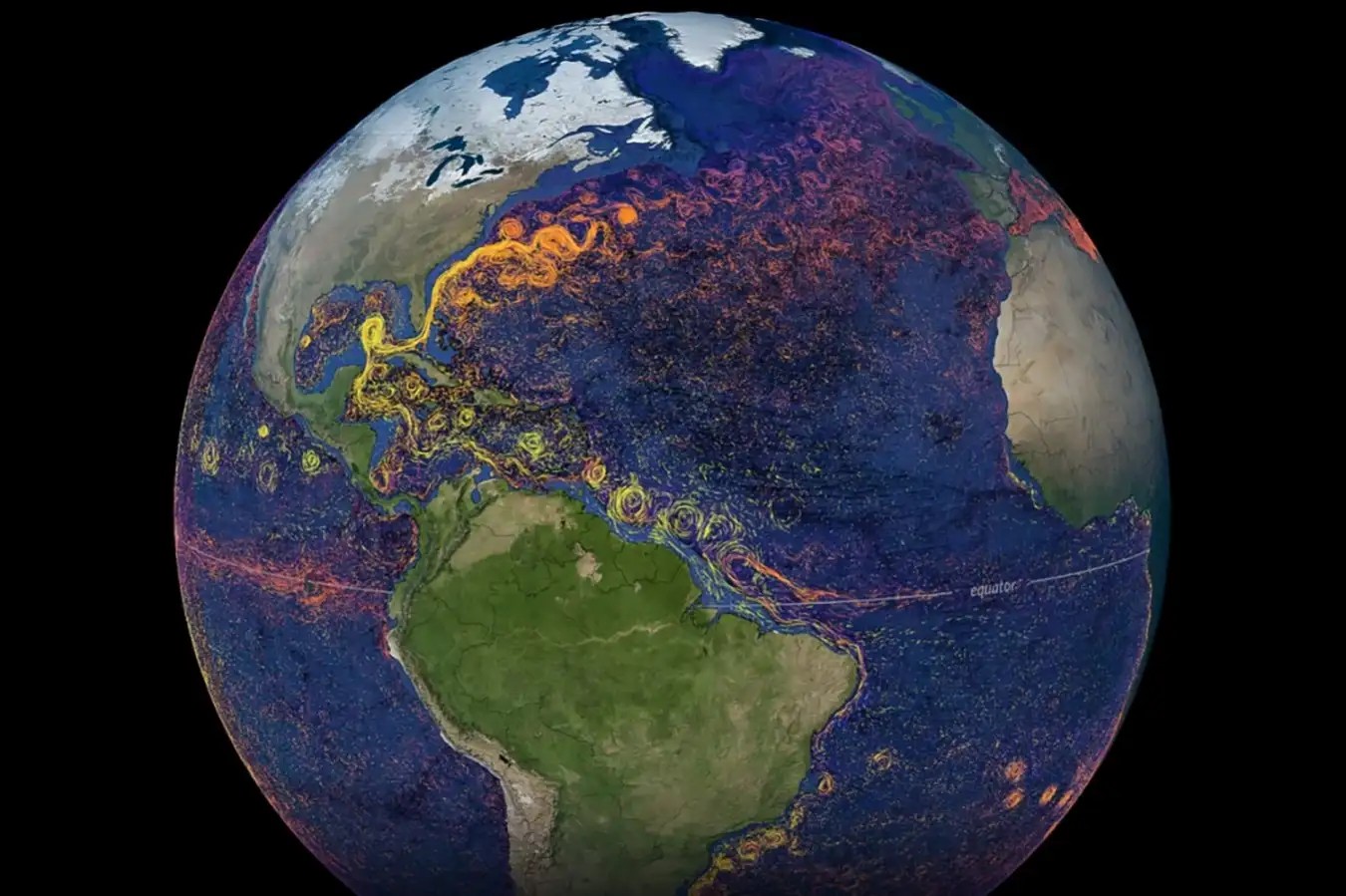
New observational data has provided the strongest evidence to date that the Atlantic Meridional Overturning Circulation (AMOC) —a vital system of ocean currents—is slowing down. Measurements from multiple locations across the Atlantic suggest the circulation is weakening at a rate that could signal a move toward a systemic collapse.
Understanding the “Ocean Conveyor Belt”
The AMOC acts as a global conveyor belt, playing a fundamental role in regulating the Earth’s climate. The process works through a continuous loop:
1. Warmth Transport: The current carries warm, salty water from the Gulf of Mexico toward the North Atlantic.
2. Climate Moderation: This heat transfer is why Western Europe enjoys much milder winters compared to similar latitudes in Canada or Russia.
3. The Sinking Mechanism: As the water reaches the north, it cools, becomes denser, and sinks to the ocean floor, flowing south along the western side of the Atlantic to complete the cycle.
Why this matters: If this cycle breaks, the heat distribution of the planet is thrown into chaos. A collapse could lead to drastically colder winters in Europe and disrupt vital monsoon patterns in Asia and Africa, affecting food security for billions.
New Data vs. Historical Models
For years, computer models have warned that the AMOC could shut down within decades, but scientists have struggled to prove this through direct observation. Because direct measurements of the current have only existed for about 20 years, drawing long-term conclusions has been difficult.
However, a recent study led by Qianjiang Xing at the University of Miami has changed the landscape by analyzing data from the RAPID-MOCHA array—a line of anchored moorings stretching from the Bahamas to the Canary Islands.
Key Findings from the Study:
- Accelerated Decline: Between 2004 and 2023, the AMOC weakened by approximately 10%.
- Flow Reduction: The flow is declining by roughly 90,000 cubic meters of water per second each year, a faster rate than previously recorded.
- Multi-Latitude Confirmation: To account for data uncertainty, researchers analyzed pressure changes across four different latitudes in the western Atlantic (near the West Indies, the US East Coast, and Nova Scotia). The results showed a consistent, coherent pattern of weakening across all locations.
The Role of Melting Ice
The primary driver behind this slowdown appears to be the melting Greenland ice sheet.
As ice melts, it pours massive amounts of freshwater into the North Atlantic. This dilutes the salinity of the ocean; because freshwater is less dense than saltwater, it does not sink as easily. This “freshening” of the water prevents the downward flow that drives the entire circulation system, effectively clogging the conveyor belt.
“The trend would be consistent with going towards the tipping point,” warns Shane Elipot of the University of Miami.
Conclusion
The study provides a “coherent picture” of a weakening deep-ocean circulation that matches long-standing climate models. While the exact timeline remains uncertain, these findings suggest the Atlantic is moving closer to a critical tipping point, necessitating urgent, expanded ocean observation to understand the scale of the coming shift.