The most perilous moment of the Artemis II mission is not the launch or the lunar orbit, but the final descent. As the Orion spacecraft returns from the Moon, it will slam into Earth’s atmosphere at speeds exceeding 30 times the speed of sound, subjecting the crew to extreme heat and intense physical pressure.
The Final Approach: Mission Control and Preparation
The home stretch of the 10-day mission begins with a coordinated effort between flight directors and the four-person crew: Commander Reid Wiseman, pilot Victor Glover, Christina Koch, and Jeremy Hansen.
As the mission nears its end, NASA’s mission control will execute a precise sequence:
– Final Steering Burn: A small engine burn in space will aim the Orion capsule toward a specific recovery zone in the Pacific Ocean, west of San Diego, California.
– Crew Preparation: Once woken from sleep, astronauts will be briefed on local weather conditions and instructed to secure all loose gear before donning their pressure suits.
– System Redundancy: Engineers will arm backup flight software to ensure the capsule can autonomously guide itself through the atmosphere in the event of a primary computer failure.
Lessons from Artemis I: Solving the Heat Shield Challenge
The reentry profile for Artemis II has been heavily influenced by the lessons learned during the uncrewed Artemis I mission. During that flight, engineers discovered that pieces of Orion’s heat shield unexpectedly broke off during descent.
The cause was identified as gas pressure buildup during a “skip” entry—a maneuver where the capsule bounces slightly off the atmosphere to shed velocity. While NASA officials emphasized that this damage would not have endangered a crew, it remains a critical technical hurdle.
To mitigate this risk, NASA has opted for a “lofted” reentry approach rather than repeating the deep bounce used in Artemis I.
This gentler path involves dipping in and out of the atmosphere with less dramatic climbs and falls, which reduces the intensity of gas-pressure spikes and keeps temperatures within a safer, more predictable range.
The Physics of Reentry: Plasma and G-Force
The transition from deep space to Earth’s atmosphere is a violent physical transformation. About 20 minutes before entry, the service module—containing the solar arrays and main engine—will detach and burn up in the atmosphere. This leaves the crew capsule alone to face the elements.
The descent involves several extreme physical phenomena:
– Extreme Velocity: Orion will enter the atmosphere at approximately 25,000 mph, potentially hitting speeds of Mach 39—surpassing the records set by the Apollo missions.
– Thermal Intensity: As air compresses in front of the capsule, temperatures will soar to roughly 5,000 degrees Fahrenheit, creating a sheath of plasma that may briefly sever radio communications.
– Physical Strain: The crew will experience approximately 3.9Gs, meaning they will feel nearly four times their own body weight pressing them into their seats.
The Splashdown: From Fireball to Ocean
Once the spacecraft has bled off enough velocity through atmospheric friction, a mechanical sequence will manage the final descent:
1. Drogue Parachutes: Two small chutes will deploy to stabilize the capsule’s orientation.
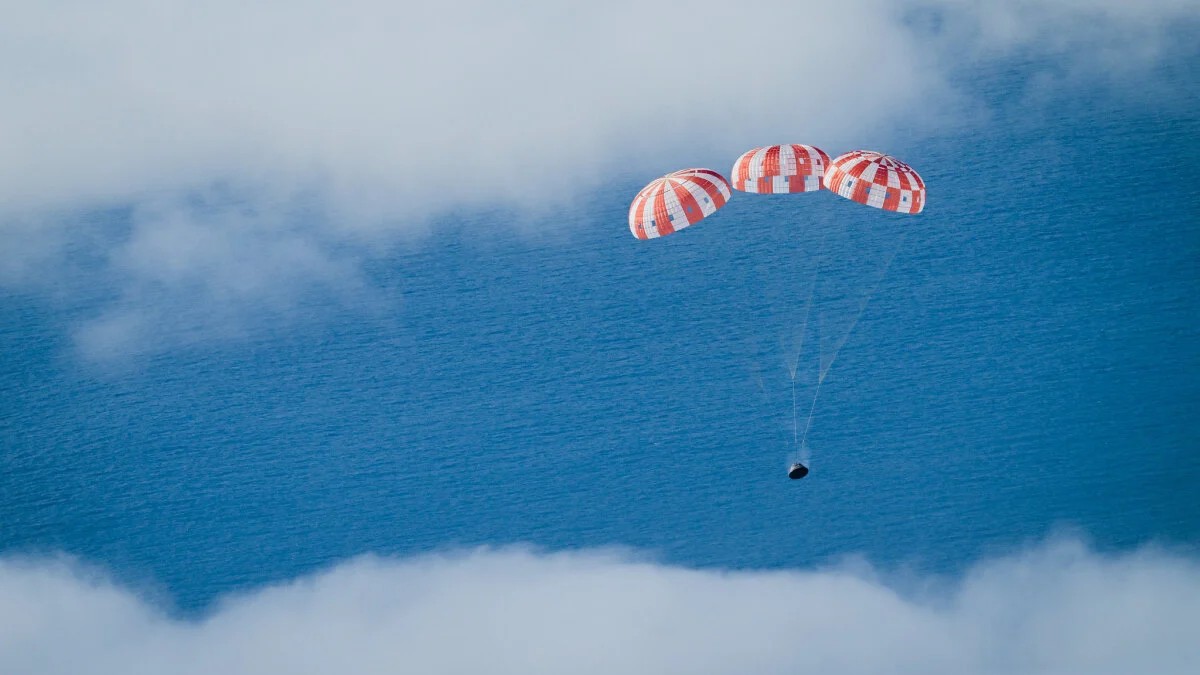
2. Main Parachutes: Three large orange parachutes will open in stages to slow the craft to a survivable speed.
3. Controlled Impact: Small thrusters will tilt the capsule to ensure it hits the Pacific waves at the optimal angle.
Following the splashdown, NASA will monitor the capsule for approximately two hours to ensure internal temperatures stabilize as the vehicle cools in the ocean.
Conclusion
The Artemis II reentry represents a high-stakes fusion of cutting-edge physics and refined engineering. By adjusting the flight path to address previous heat shield issues, NASA aims to safely navigate the “fireball” and return its crew from the lunar frontier to Earth.