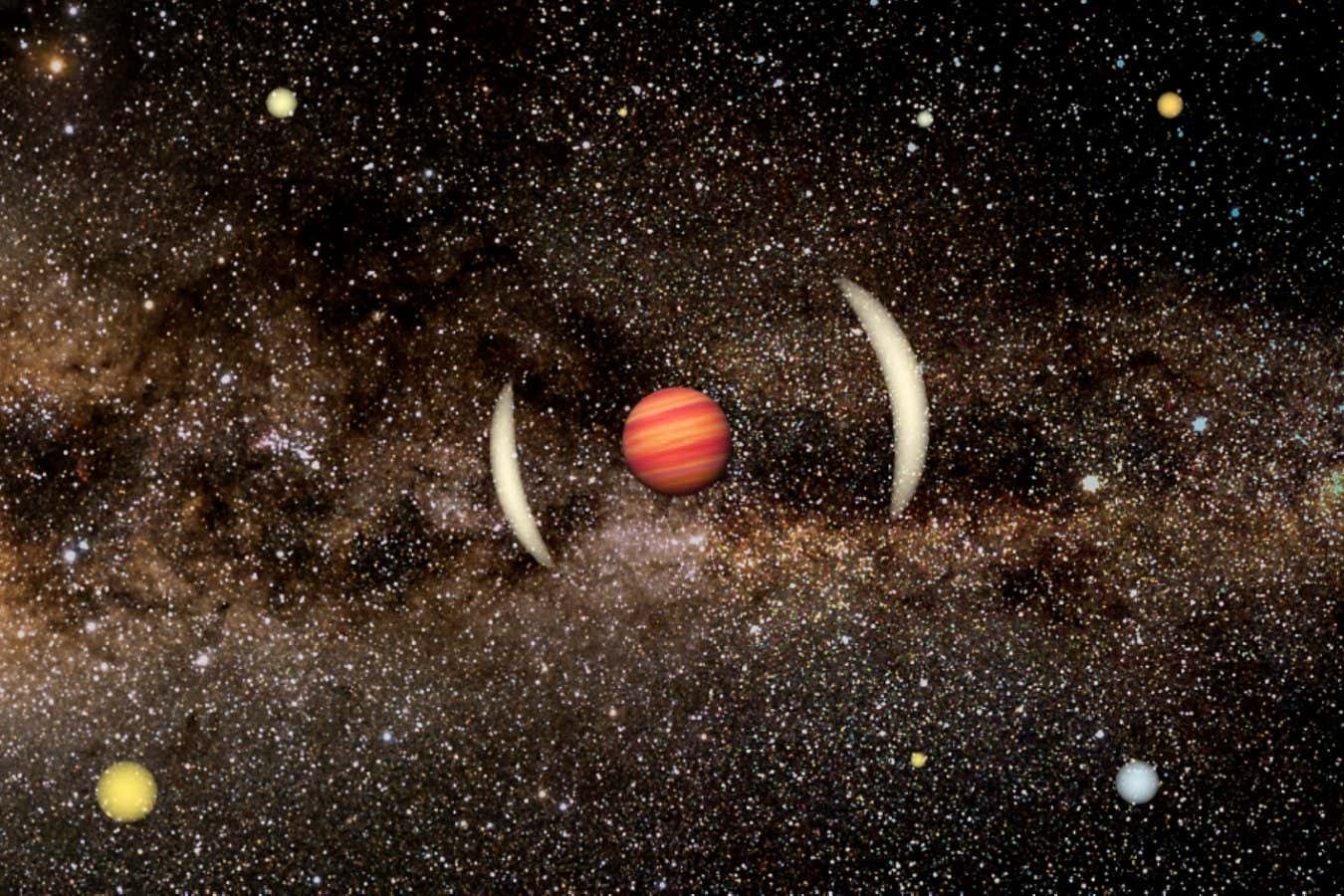
Researchers have, for the first time, accurately measured the mass of a free-floating planet – a world roughly the size of Saturn drifting alone in space, some 10,000 light-years from Earth. This discovery fills a critical gap in planetary science, known as the “Einstein desert,” where planets between the size of Neptune and Jupiter have been notably absent in observed rogue populations.
The Hunt for Lonely Worlds
Most rogue planets detected so far are either super-Jupiters (massive gas giants) or smaller than Neptune. The reason for this gap is theorized to be linked to how planets form and are ejected from star systems. Lighter worlds are easily kicked out, while heavier ones can sometimes form in isolation, much like stars. This new planet, identified as KMT-2024-BLG-0792 (also known as OGLE-2024-BLG-0516), bucks this trend by weighing in at roughly one-fifth the mass of Jupiter, making it a rare find.
How It Was Spotted
The team, led by Andrzej Udalski from the University of Warsaw, spotted the planet independently using two ground-based telescopes. The key to measuring its mass was a combination of these observations and data from the Gaia space telescope. They used a technique called gravitational microlensing, where a planet’s gravity bends the light from a distant star, creating a temporary halo effect. The simultaneous detection from Earth and Gaia provided the necessary data to calculate the planet’s mass precisely.
Why This Matters
“Mass is the main parameter deciding on the classification as a planet,” says Udalski, confirming this as the first technically verified free-floating rogue planet.
This confirmation is significant because it validates the existence of these solitary worlds and opens the door to studying planetary formation in new ways. It also suggests that many planetary systems, including our own, may have ejected planets during their early stages. The upcoming Nancy Grace Roman space telescope, slated for launch in 2027, promises to uncover many more such rogue planets, potentially revolutionizing our understanding of how planetary systems evolve.
The discovery of this Saturn-sized rogue planet is not just about finding another world; it’s about filling a critical piece of the puzzle in our knowledge of planet formation and the prevalence of lonely worlds drifting through the galaxy.