Astronomers may be witnessing a rare cosmic event in real-time. New analysis of the blazar galaxy Mrk 501 suggests that its core contains not one, but two supermassive black holes locked in a tight orbital dance—a pairing that could culminate in a massive collision within the next century.
The Discovery of a Double Jet
The study, led by astronomer Silke Britzen of the Max Planck Institute for Radio Astronomy, focuses on the peculiar behavior of Mrk 501, located approximately 464 million light-years away. As a blazar, this galaxy features an active supermassive black hole with a high-speed jet of plasma pointed almost directly at Earth, making it incredibly bright but difficult to study in detail.
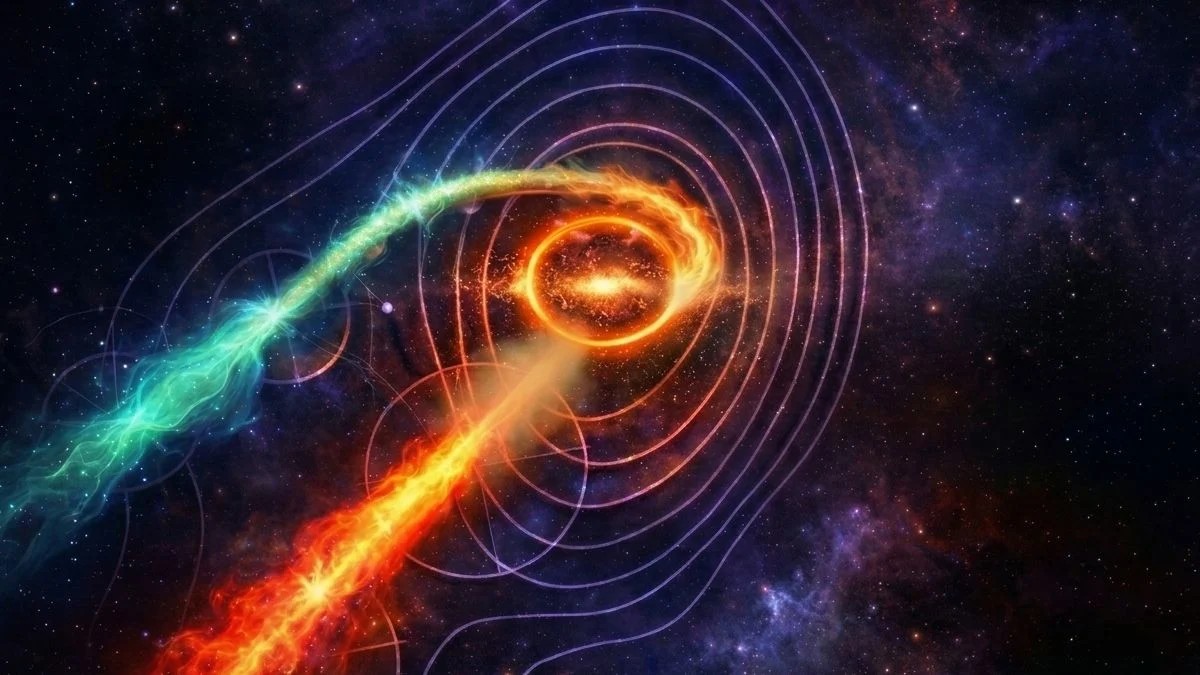
By using ultra-high-resolution radio telescopes to monitor the galaxy over a 23-year period, researchers identified a phenomenon never before seen in a blazar core: a double jet system.
Key findings from the analysis include:
- A “Wobbling” Jet: The researchers observed a seven-year cycle in the light fluctuations, which resembles a spinning top teetering on its axis. This suggests the entire jet system is swaying.
- A Rapid Orbit: A second, shorter cycle of approximately 121 days was detected. This is consistent with two black holes orbiting each other at a distance of 250 to 540 times the distance between Earth and the Sun.
- Counter-rotating Motion: The data revealed a second, fainter jet looping counterclockwise around the radio core, a signature that strongly implies a binary black hole system.
Solving the “Final Parsec Problem”
This discovery is significant because it addresses one of the most enduring mysteries in cosmology: the final parsec problem.
When two galaxies collide, their central supermassive black holes are drawn toward each other. As they orbit, they lose energy to surrounding stars and gas, causing their orbit to shrink. However, theoretical models suggest that once the black holes reach a distance of about one parsec (roughly 3.26 light-years), they may run out of nearby material to interact with. Without this “friction,” their orbits could stall, potentially lasting longer than the current age of the universe.
If the findings in Mrk 501 are confirmed, the two black holes are separated by only 0.0026 parsecs. This indicates that these cosmic giants have successfully bypassed the “stall” and are actively spiraling toward one another, proving that there are mechanisms in place to bridge that final gap.
Why This Matters for Science
Supermassive black holes—ranging from millions to billions of times the mass of our Sun—are the gravitational anchors of major galaxies. Yet, we still struggle to understand how they grow to such immense sizes. While smaller “stellar-mass” black holes are well-understood, the evolution of these behemoths remains shrouded in mystery.
The merger of two supermassive black holes is considered a “white whale” of astronomy. Because of their immense scale, detecting the gravitational waves they emit requires specialized tools like pulsar timing arrays.
“If gravitational waves are detected, we may even see their frequency steadily rise as the two giants spiral toward collision, offering a rare chance to watch a supermassive black hole merger unfold.”
— Héctor Olivares, astronomer at Radboud University
Conclusion
If the binary nature of Mrk 501 is confirmed, it would provide humanity with a front-row seat to a monumental cosmic merger. With a predicted collision timeframe of less than 100 years, this galaxy offers a unique opportunity to observe the life cycle of supermassive black holes within a single human lifetime.