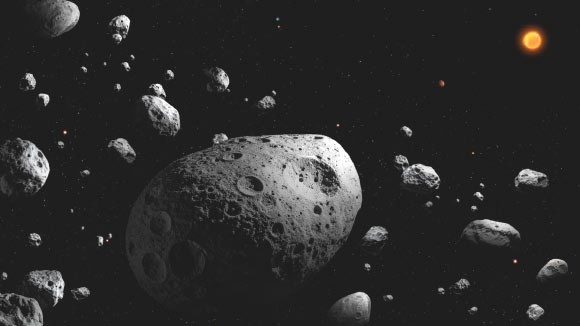
Astronomers have identified an asteroid, 2025 MN45, rotating at an unprecedented speed using early data from the Vera C. Rubin Observatory’s Legacy Survey of Space and Time (LSST) camera. This discovery, detailed in The Astrophysical Journal Letters, is not just a record-breaker but also forces scientists to reconsider assumptions about asteroid composition and evolution.
Why Asteroid Spin Matters
Asteroids rotate at varying speeds, but these rates reveal key details about their formation, internal structure, and any violent collisions they’ve endured. A fast spin suggests an asteroid may be a fragment of a larger, shattered body, or that its material is unusually strong. Most asteroids are “rubble piles”—loosely held-together rock fragments—meaning there’s a speed limit beyond which they’d break apart.
For asteroids in the main belt, that limit is around 2.2 hours. Any faster, and the asteroid needs serious structural integrity to stay intact. The faster it spins and the larger it is, the stronger its material must be.
The Record-Breaking Asteroid: 2025 MN45
The newly discovered asteroid 2025 MN45 is 710 meters in diameter and completes a full rotation in just 1.88 minutes. This makes it the fastest-spinning asteroid over 500 meters ever observed. According to Dr. Sarah Greenstreet, it must be composed of material with the strength of solid rock—a surprising find given that most asteroids are thought to be fragile rubble piles.
“Clearly, this asteroid must be made of material that has very high strength in order to keep it in one piece as it spins so rapidly.” – Dr. Sarah Greenstreet
The team also identified 16 other super-fast rotators (spinning between 13 minutes and 2.2 hours) and three ultra-fast rotators (under five minutes per spin). All 19 newly identified asteroids are at least 90 meters long. Other notable discoveries include asteroids 2025 MJ71, 2025 MK41, 2025 MV71, and 2025 MG56.
Rubin Observatory’s Breakthrough Capability
The Vera C. Rubin Observatory’s LSST camera is uniquely suited to detect these fast-spinning asteroids. Its high-resolution, time-domain data allows for discoveries previously impossible. The observatory’s ability to capture detailed, rapid changes in the sky is reshaping our understanding of the Solar System.
The discovery of 2025 MN45 and other fast-spinning asteroids challenges existing models of asteroid composition and highlights the importance of continued observation with advanced instruments like the Rubin Observatory. This means we may need to revise how we think about asteroid formation, structure, and the potential hazards they pose.