Saturn’s magnetic shield is not symmetrical, and new analysis of data from the Cassini mission reveals why. This discovery offers insights into how planetary magnetic fields form, particularly on rapidly spinning gas giants, and has implications for the search for life on moons like Enceladus.
A Lopsided Magnetic Bubble
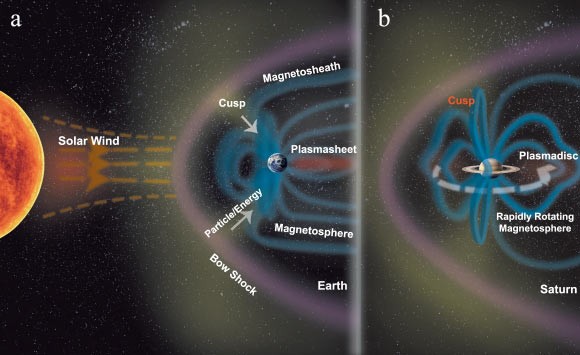
Planetary magnetospheres act as shields against the solar wind, protecting atmospheres from harmful charged particles. Saturn’s magnetic field is exceptionally large, extending over ten times the planet’s diameter. However, unlike Earth’s relatively symmetrical field, Saturn’s is skewed – pulled to one side by a combination of its fast rotation and material spewed from its moons.
How Saturn’s Field Differs
Researchers at University College London, led by Professor Andrew Coates, studied six years of Cassini data to pinpoint Saturn’s magnetic cusp – the region where magnetic field lines curve back into the planet, funneling particles into the atmosphere. They found the cusp consistently appears off-center, between 1:00 PM and 3:00 PM as viewed from the Sun, instead of directly at noon like on Earth.
This shift is driven by two key factors: Saturn’s extremely rapid rotation (a day lasts just 10.7 hours) and the dense plasma—ionized gas—it drags along with it. This plasma is largely derived from gases released by Saturn’s moons, especially Enceladus, which has subsurface oceans that may harbor life.
Implications for Future Missions
Understanding Saturn’s magnetic environment is crucial because of the planned ESA mission to Enceladus in the 2040s. The cusp is the primary entry point for the solar wind, so mapping its location helps model the entire magnetic bubble.
“The differences between Saturn’s magnetic structure and that of Earth point to a unified fundamental process governing solar wind interaction across different planets,” said Professor Zhonghua Yao of the University of Hong Kong.
The study reinforces the idea that rapid planetary spin and active moons can dominate magnetosphere formation, rather than solely relying on the solar wind. This has broader implications for understanding the magnetic fields of exoplanets and assessing their habitability.
A Key to Exoplanet Studies
By combining Cassini observations with simulations, researchers confirm that Saturn’s unique field is shaped by its rapid rotation and the heavy plasma from Enceladus. This provides a reference point for future exploration of Jupiter and Saturn’s environments, as well as for interpreting the magnetic signatures of distant worlds.
Ultimately, this research deepens our understanding of how planets interact with space weather, and how that interaction might influence the conditions for life elsewhere in the universe.
The findings were published in Nature Communications (Xu et al., 2024).