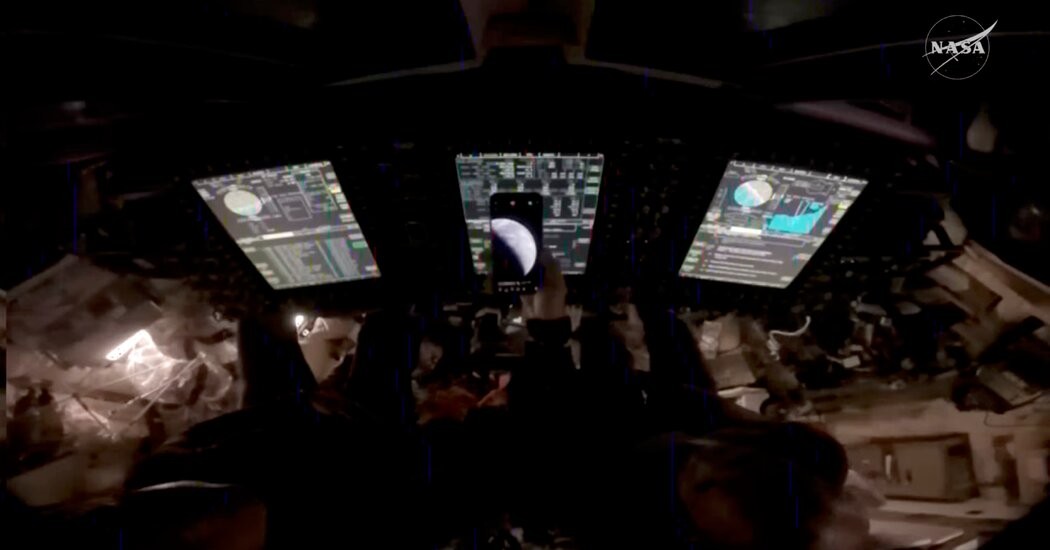
After more than half a century of waiting, humanity has once again traveled around the Moon. On Friday evening, the four-person crew of the Artemis II mission successfully splashed down in the Pacific Ocean, marking the conclusion of a historic 10-day journey that has redefined the boundaries of modern space exploration.
A Successful Return to Earth
The Orion spacecraft hit the water near San Diego at 8:07 p.m. ET, following a high-speed re-entry that saw the capsule reach speeds of nearly 24,700 mph. Despite the intense physical demands of the mission, NASA confirmed that all four astronauts—Reid Wiseman, Victor Glover, Christina Koch, and Jeremy Hansen—are in “excellent condition.”
The recovery process, managed by NASA and the U.S. Navy, involved a precise sequence of events:
– Stabilization: Upon splashdown, airbags inflated to keep the capsule upright against ocean currents.
– Extraction: Recovery teams used inflatable platforms to safely lift the crew from the capsule.
– Transport: The astronauts were flown via helicopter to the U.S.S. John P. Murtha, where they will undergo medical evaluations before returning to NASA’s Johnson Space Center in Houston on Saturday.
Breaking Records and Barriers
The Artemis II mission was not merely a return to lunar orbit; it was a mission of “firsts” that broke several historical precedents:
- Distance Record: The crew surpassed the distance record set by Apollo 13 in 1970. By swinging around the far side of the Moon, they reached a distance of 252,756 miles from Earth—roughly 4,100 miles farther than the Apollo 13 crew.
- Diversity in Space: The crew represents a milestone for inclusivity in space exploration. Victor Glover is the first Black man to travel around the Moon, Christina Koch is the first woman to do so, and Jeremy Hansen is the first Canadian astronaut to participate in a lunar mission.
- Scientific Discovery: The crew observed parts of the Moon’s far side that had remained in shadow during the Apollo era and witnessed a rare 53-minute solar eclipse.
The Technical Triumph of Orion
While the mission was a success, it was not without its hurdles. The crew dealt with communication glitches and technical issues with the spacecraft’s life support systems (including plumbing). However, these challenges provided invaluable data.
The mission proved that the Orion spacecraft’s critical systems —including propulsion and life support—are capable of sustaining human life during the extreme stresses of deep space travel. The re-entry phase itself was a feat of engineering, as the heat shield protected the crew from temperatures reaching 5,000 degrees Fahrenheit —twice as hot as molten lava.
“What a journey,” said Mission Commander Reid Wiseman upon successful splashdown. “We are stable one. Four green crew members.”
Why This Matters
The success of Artemis II signals a pivotal shift in space policy. While the Apollo missions were primarily focused on reaching the Moon, the Artemis program is designed to establish a sustainable human presence in deep space. By proving that the Orion capsule can safely transport a diverse crew around the Moon and back, NASA has laid the essential groundwork for future missions to land humans on the lunar surface and, eventually, reach Mars.
Conclusion: The successful splashdown of Artemis II marks the end of a decade-defining mission that has restored humanity’s lunar capabilities and set the stage for the next era of interplanetary exploration.