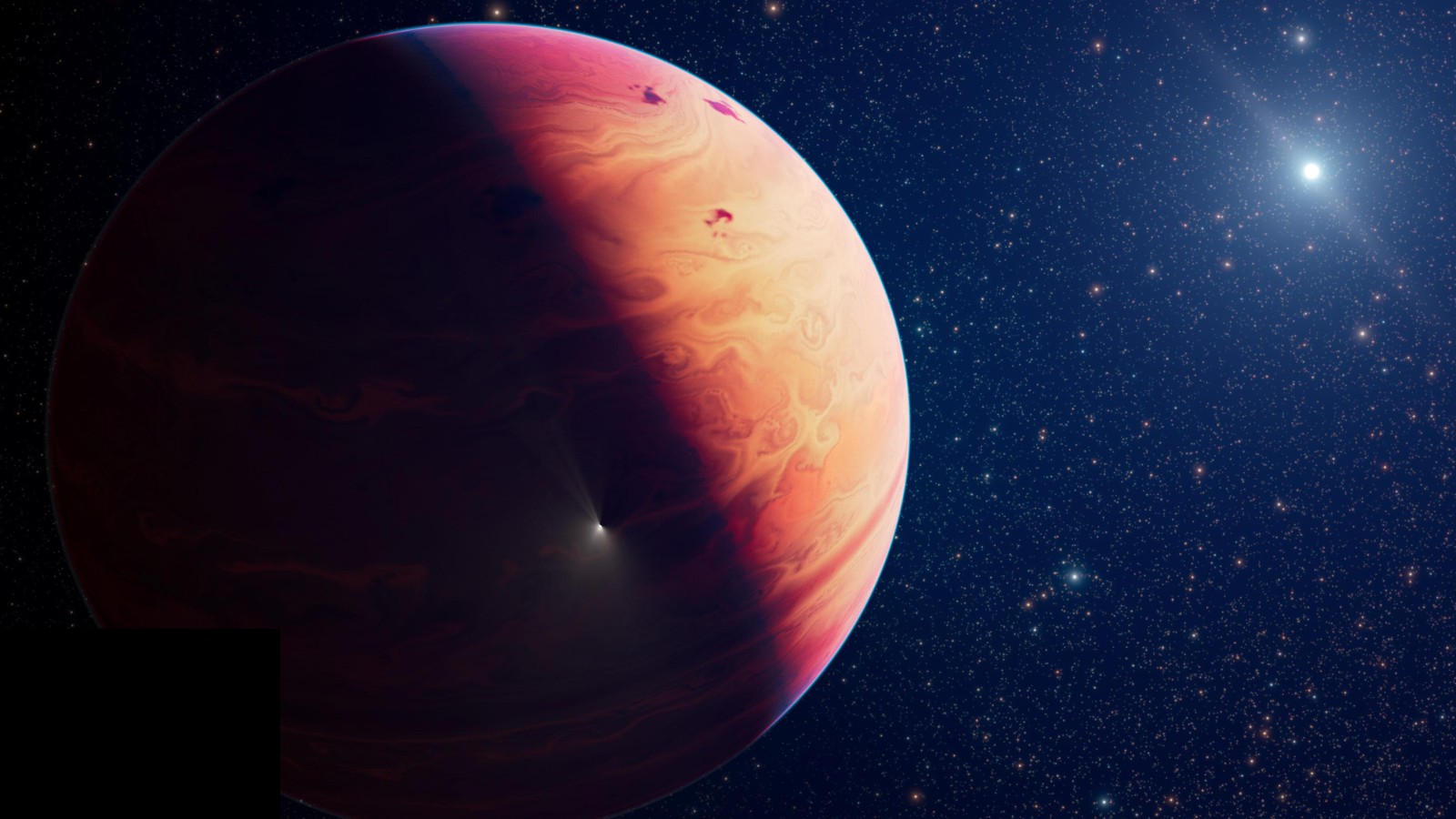
Astronomers are using the James Webb Space Telescope (JWST) to investigate a cosmic mystery: how do massive gas giants form, and where exactly is the line that separates a planet from a star?
Recent observations of a distant world known as 29 Cygni b are providing critical evidence that could reshape our understanding of planetary birth.
The Mystery of the “Supergiant” Planet
Located 133 light-years from Earth, 29 Cygni b is a massive gas giant with roughly 15 times the mass of Jupiter. Because of its immense size, it sits at a scientific crossroads. Traditionally, astronomers categorize planetary formation into two distinct methods:
- Bottom-up formation: Small clumps of rock and ice gradually collide and merge to build a planet. This is how most planets in our solar system formed.
- Top-down formation: Dense patches of gas and dust collapse directly under their own gravity—the same process that creates stars.
The challenge for scientists is that “bottom-up” processes struggle to explain how a planet can grow so large, while “top-down” processes are usually reserved for much larger celestial bodies. 29 Cygni b defies easy categorization.
Evidence for a “Bottom-Up” Origin
While its massive weight suggests it might have formed like a star (top-down), its orbital characteristics suggest otherwise. 29 Cygni b orbits its parent star at a distance of approximately 1.5 billion miles —a distance comparable to Uranus in our own solar system. This wide orbit is a hallmark of the “bottom-up” method.
Using the JWST’s Near-Infrared Camera (NIRCam), researchers have uncovered two key pieces of evidence that support this theory:
- A “Metal-Rich” Atmosphere: By analyzing how carbon dioxide and carbon monoxide absorb light, astronomers measured the abundance of “metals” (elements heavier than helium) in the planet’s atmosphere. They found that 29 Cygni b is 150 times richer in metals than Earth and significantly more metal-rich than its host star. This suggests the planet grew by “greedily” vacuuming up metal-heavy clumps of material from its surrounding protoplanetary disk.
- Orbital Alignment: The team discovered that the planet’s orbit is aligned with the rotation of its parent star. This alignment strongly indicates that the planet formed within a protoplanetary disk —the swirling ring of dust and gas that surrounds a young star—rather than collapsing independently from a separate cloud.
Why This Matters
This discovery is significant because it suggests that the “bottom-up” method is much more powerful than previously thought. If a planet can accumulate enough heavy material from its disk, it can potentially reach supergiant proportions without needing to undergo the star-like process of direct gravitational collapse.
The research team is currently part of a larger program to image four similar exoplanets. These worlds are all relatively young, hot, and possess masses between one and 15 times that of Jupiter.
By studying these “middle-ground” worlds, scientists hope to finally determine if the most massive planets in the Milky Way are born like stars, or if they are simply much larger versions of the planets we see in our own neighborhood.
Conclusion
The findings from 29 Cygni b suggest that massive gas giants can form through the gradual accumulation of metal-rich material within a protoplanetary disk. This discovery provides a vital link in understanding the complex spectrum of how celestial bodies are born.