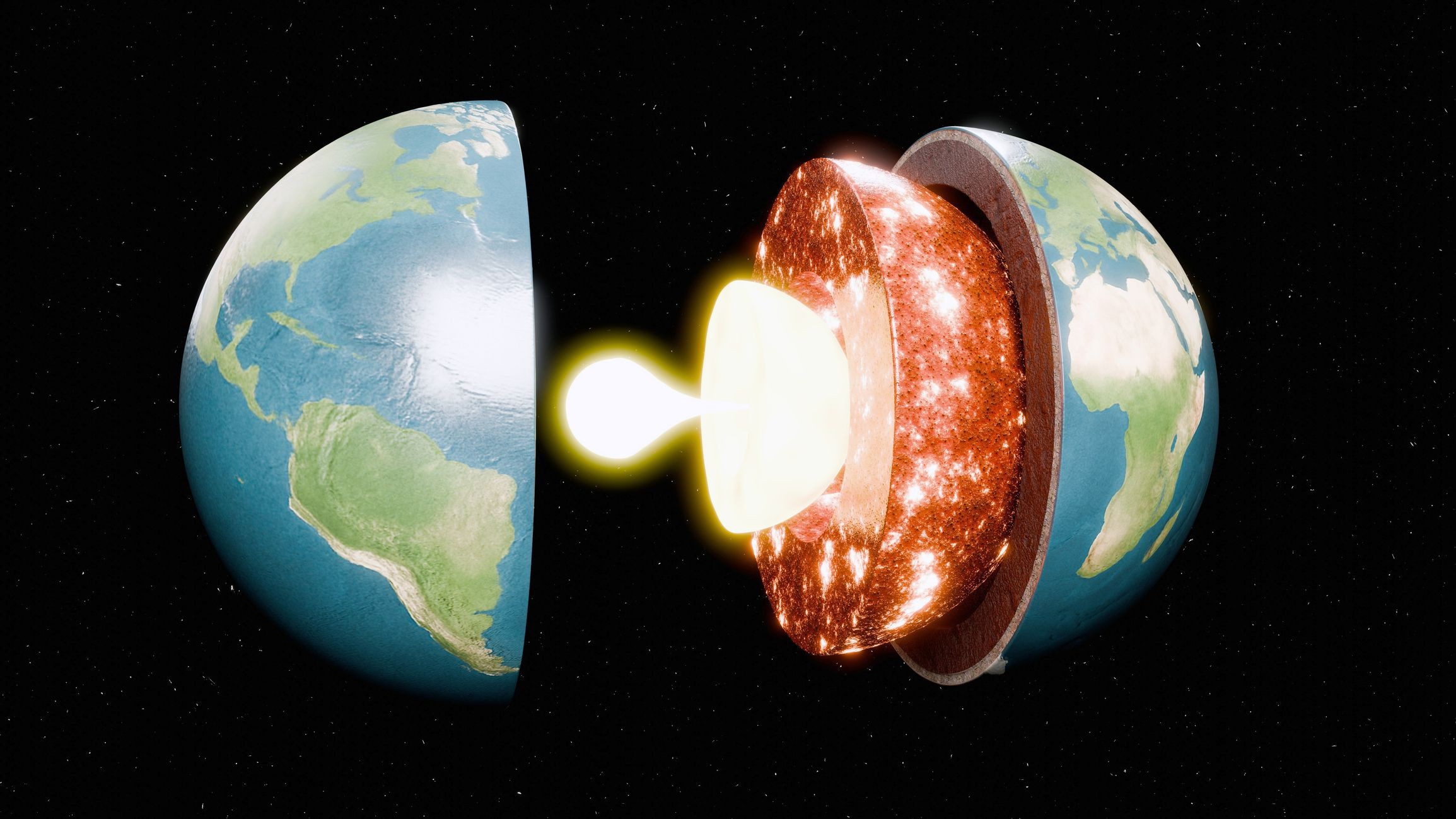
Earth holds a massive amount of hydrogen – far more than previously understood – locked deep within its core. A new study reveals that the core contains up to 45 times more hydrogen than all the oceans combined, settling a long-standing debate about how this crucial element arrived on our planet. This discovery isn’t just about numbers; it reshapes our understanding of Earth’s formation and the delivery mechanisms of key elements.
The Long-Standing Debate
For decades, scientists have argued over when hydrogen reached Earth. Was it delivered early, during the planet’s formation, or later, through comet impacts? The difficulty lies in measuring hydrogen deep inside Earth. It’s the smallest element, making precise detection under extreme pressure and heat nearly impossible.
A New Approach: Atom Probe Tomography
Previous estimates relied on X-ray diffraction, which involves analyzing how materials scatter X-rays to quantify their composition. However, this method made crucial assumptions about iron crystal structures and the behavior of other core elements like silicon and oxygen. The new research bypasses these limitations by using atom probe tomography. This advanced technique creates 3D nanoscale maps of elemental composition, even under extreme conditions.
To simulate the core’s formation, researchers squeezed a sample of iron metal between two diamonds to create immense pressure, then heated it to nearly 5,000°C (8,730°F). Atom probe tomography revealed that hydrogen, oxygen, and silicon dissolve into iron crystals simultaneously, altering their structure in ways previously unknown.
Key Findings: Hydrogen’s Early Arrival
The results show that hydrogen constitutes 0.07% to 0.36% of Earth’s core by weight. This concentration suggests hydrogen was incorporated during the planet’s initial formation, not added later by comets. If comets had been the primary source, hydrogen would be concentrated in shallower layers, not the core. The study is the first to pinpoint the mechanism of hydrogen entering Earth’s core.
“This is the first time that the mechanism of how hydrogen enters the core was identified,” says study lead author Dongyang Huang.
This finding isn’t just academic. Understanding how hydrogen ended up in Earth’s core could provide insights into planetary evolution, the distribution of elements in other rocky planets, and even the conditions necessary for life to emerge. The Earth’s core remains a frontier of discovery, and this study marks a significant step forward in unraveling its secrets.