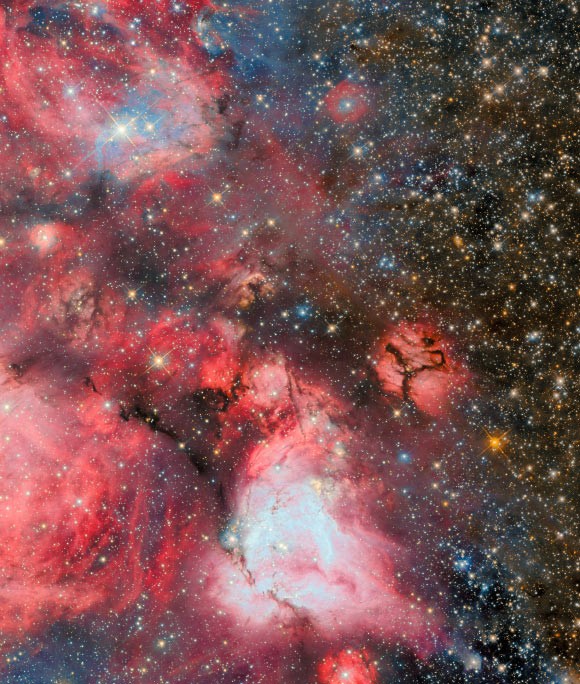
Astronomers have released a stunning new image from the Hubble Space Telescope, showcasing a portion of N159 – an enormous stellar nursery located 160,000 light-years away in the Dorado constellation. The cloud is part of the Tarantula Nebula, and one of the largest star-forming regions in the Large Magellanic Cloud, a satellite galaxy of our own Milky Way.
Scale and Structure of N159
This gigantic cloud spans over 150 light-years, which is roughly ten million times the distance between Earth and the Sun. Within N159, at least four distinct regions of ionized hydrogen gas (H II regions) are separated by distances ranging from 33 to 65 light-years. These regions are where stars are born, and the sheer scale demonstrates how prolific star birth can be in certain galactic environments.
Stellar Winds Sculpt the Cloud
The newly formed, massive stars within N159 unleash powerful stellar winds. These winds carve out dramatic structures – ridges, arcs, and filaments – within the cloud, shaping its appearance. The process is a violent interplay between gravity collapsing gas into stars and the energy released by those stars pushing back against their surroundings.
Insights into Star Formation
Previous studies of N159’s composition have provided valuable data on the chemistry and physical conditions necessary for star formation. The Hubble image adds to this understanding by revealing the dynamic interplay of light and gas. The red glow visible in the image comes from excited hydrogen atoms, illuminated by the hot, high-mass stars that just ignited within the cloud.
Why this matters : N159 is a laboratory for understanding star formation processes in environments similar to those that existed in the early universe when star birth rates were much higher. Studying such regions gives us insight into how galaxies evolved and how the first stars came to be.
The new image from Hubble provides a clear view of star formation in action, confirming that these clouds are both beautiful and crucial for understanding galactic evolution.