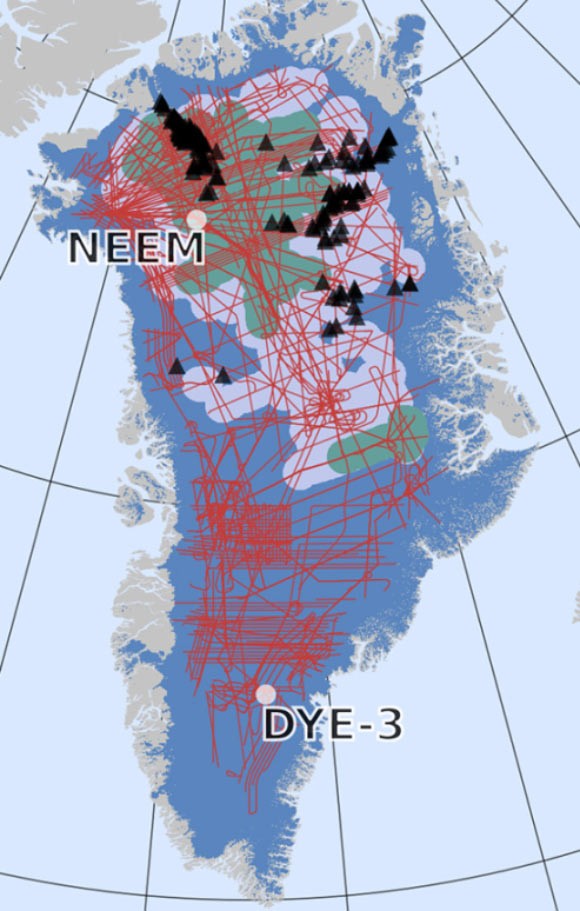
Scientists have solved a long-standing mystery within the Greenland Ice Sheet: strange, plume-like structures deep under the surface are caused by thermal convection – a process typically associated with Earth’s mantle, not ice. This unexpected finding, published in The Cryosphere, could significantly refine climate models and improve predictions about sea-level rise.
The Discovery: Ice That Behaves Like Boiling Water
For years, glaciologists observed unusual features within the ice sheet that defied conventional understanding. New research from the University of Bergen, NASA, and the University of Oxford reveals that the deep ice is ten times softer than previously assumed, allowing heat to rise and create convection currents.
As Professor Andreas Born of the University of Bergen explains, “We typically think of ice as a solid material… the discovery that parts of the Greenland Ice Sheet actually undergo thermal convection, resembling a boiling pot of pasta, is as wild as it is fascinating.”
Why This Matters: Refining Climate Predictions
The implications are substantial. Thermal convection influences how ice flows and melts, and current models may underestimate this effect. While softer ice doesn’t automatically mean faster melting, it introduces a previously unaccounted-for variable.
Dr. Robert Law, lead author of the study, clarifies: “Improving our understanding of ice physics is a really major way to be more certain about the future… but on its own, softer ice does not necessarily mean that the ice will melt faster.”
This discovery demands further research to determine the precise impact on ice sheet stability. The current models of ice flow and melt rates may need adjusting to account for these internal convection currents.
Greenland: An Unusually Dynamic Ice Sheet
The research also highlights the unique nature of Greenland’s ice sheet, which is over one thousand years old and supports a permanent human population along its margins. This makes the study even more critical, as Greenland isn’t just a geological feature; it’s a region with a rich history and a present-day society that will be directly affected by changes in the ice sheet.
Ultimately, understanding these hidden processes is essential for preparing coastal communities for the inevitable changes ahead. The more we learn about how the ice behaves, the more accurate our predictions will become, allowing for better adaptation strategies.
“The more we learn about the hidden processes inside the ice, the better prepared we’ll be for the changes coming to coastlines around the world.”
The study underscores that Greenland is a dynamic system, and its response to climate change will be far more complex than previously thought.