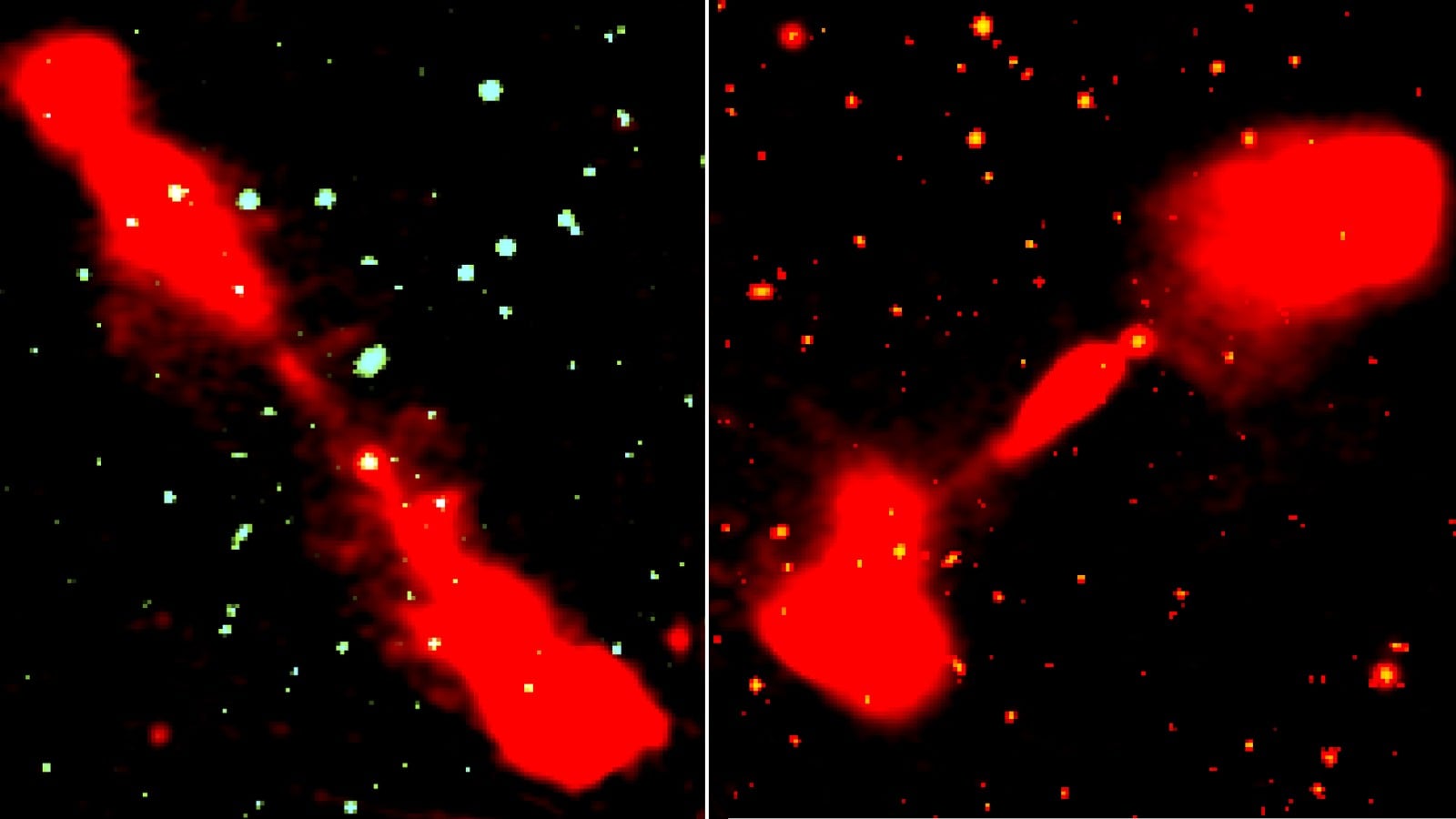
Astronomers have identified 53 extraordinarily large quasars, each powered by a supermassive black hole and emitting jets of matter that extend up to 7.2 million light-years. This makes them 50 times wider than our Milky Way galaxy, representing some of the most immense structures ever observed in the universe.
The Scale of These Cosmic Giants
These structures, known as Giant Radio Quasars (GRQs), were discovered through a survey of 369 radio quasars using the Giant Meterwave Radio Telescope (GMRT) in India. The GMRT’s broad coverage and sensitivity were essential for detecting these distant, enormous structures.
The sheer scale is almost incomprehensible: imagine 20 to 50 Milky Way galaxies laid end-to-end. This highlights just how extreme these objects are.
How Quasars Form and Evolve
Quasars are galactic cores with supermassive black holes at their center, actively feeding on surrounding gas and dust. Not all black holes become quasars, but when they do, the process is cataclysmic. The infalling matter forms a rotating disk, heating to extreme temperatures and emitting intense radiation.
A crucial step in this process is the formation of jets. Magnetic fields channel ionized gas away from the black hole at near-light speed, creating twin jets that expand into vast lobes over millions of years.
Environmental Influence on Jet Development
The team found that about 14% of these GRQs reside in dense galactic groupings or along cosmic filaments. These environments significantly affect how jets evolve:
– In denser regions, jets are slowed, bent, or disrupted by surrounding gas.
– In emptier regions, jets expand freely through intergalactic space.
This suggests the environment surrounding a quasar plays a major role in shaping its structure.
Asymmetry and Evolution Over Time
Many of these quasars exhibit radio jet asymmetry —one jet is longer or brighter than the other. This disparity reveals the jets are colliding with uneven cosmic conditions.
The further away these quasars are, the greater the asymmetry. This is likely due to the early universe being denser and more chaotic, causing jets to distort and collide with gas clouds.
These findings provide critical insights into both the evolution of quasars and the nature of the intergalactic medium. The faint connecting emissions between lobes often make them hard to detect, making low-frequency radio surveys essential for identifying these systems.
Ultimately, these GRQs are a reminder of the extreme physics at play in the cosmos, and how the environment can dramatically shape even the most powerful structures in the universe.