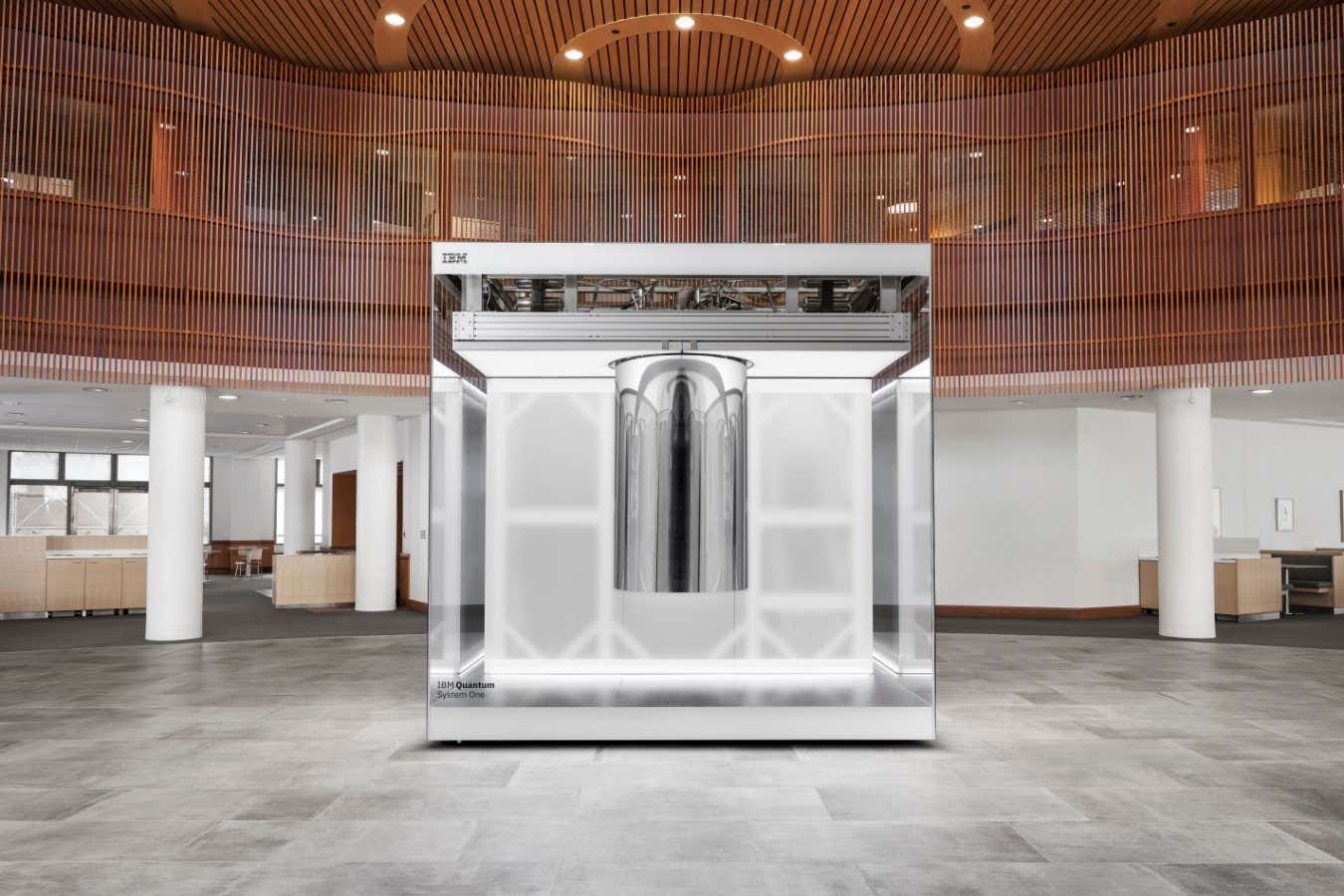
A collaborative team of researchers has achieved a significant milestone in computational chemistry: simulating the properties of a molecule containing 12,635 atoms. This breakthrough was accomplished not by a standalone quantum computer, but through a hybrid approach that leverages the unique strengths of both quantum processors and conventional supercomputers.
This development marks a critical step toward using quantum computing for drug discovery. While quantum computers are theoretically ideal for modeling the complex quantum states of electrons in proteins, they currently lack the stability and scale to handle such tasks alone. By combining resources, the team demonstrated that practical progress is possible even with today’s imperfect hardware.
The Hybrid Approach to Solving Quantum Problems
Simulating drug molecules requires calculating the precise quantum states and energies of their electrons. On classical computers, these calculations are often approximations that struggle with complexity. Quantum computers, which operate on the principles of quantum mechanics, are naturally suited for this work. However, current quantum devices are small and prone to errors, limiting their standalone utility.
To overcome these limitations, researchers from the Cleveland Clinic, IBM, and the Japanese institute RIKEN developed a hybrid workflow. They divided the computational load between two IBM Heron quantum computers and two of the world’s most powerful supercomputers, Fugaku and Miyabi-G.
The process involved a sophisticated back-and-forth exchange:
* Quantum Computers: Handled specific, complex calculations for fragments of the molecule.
* Supercomputers: Processed the broader structural data and integrated the results.
This collaborative effort ran for over 100 hours, resulting in a simulation of two “protein-ligand complexes”—combinations of a protein and a small molecule that are fundamental to biomedical research. The team also simulated the molecules in a layer of water, adding a layer of realism that mirrors laboratory conditions.
Why This Matters: Bridging the Gap to Practical Use
The molecule simulated in this study is approximately 40 times larger than the previous record holder for quantum-assisted simulations. While the accuracy of the results was competitive with standard methods rather than unequivocally superior, the achievement lies in its feasibility.
“This has been a dream of mine, and here we are,” said Kenneth Merz of the Cleveland Clinic, reflecting on the long-held goal of using quantum tech for biomedical insights.
Jerry Chow of IBM noted that the hybrid process was likely faster than it would have been using supercomputers alone, suggesting that quantum hardware already offers value for specific parts of the calculation. This challenges the notion that we must wait for perfect, error-free quantum computers before seeing practical benefits.
Expert Perspective: Progress Amidst Uncertainty
The scientific community views this work as a significant, albeit preliminary, step. Junyu Liu from the University of Pittsburgh praised the team for offering “practical steps towards useful quantum calculations using hardware that’s actually in use.” He described the scale of the experiment as “genuinely impressive.”
However, Liu also highlighted an open question: whether this hybrid method can be mathematically proven to guarantee superior performance—known as quantum advantage —in all cases. For now, the approach serves as a bridge, making quantum computers useful before they are fully error-proof.
As Chow emphasized, this record is not a definitive endpoint but a beginning. The field is currently in a phase of pushing the boundaries of what is possible, with more exciting developments likely on the horizon.
Conclusion
This hybrid simulation demonstrates that quantum computers can already contribute to complex scientific problems when paired with classical supercomputers. While full quantum advantage remains a future goal, this breakthrough proves that practical, large-scale molecular simulations are within reach today.