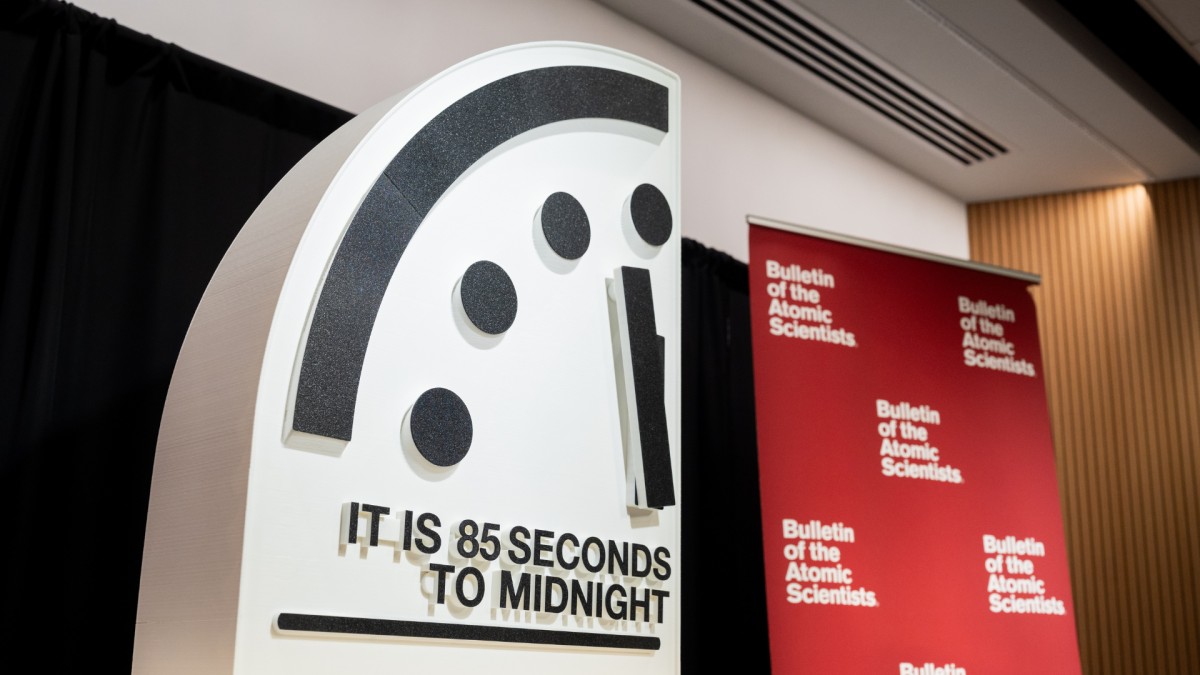
The Doomsday Clock, a symbolic representation of humanity’s proximity to global catastrophe, has been set to 85 seconds to midnight – the closest it has ever been to signifying apocalypse. Scientists from the Bulletin of the Atomic Scientists cite escalating nuclear tensions, unchecked climate change, biological threats, and the dangers of artificial intelligence as driving this unprecedented warning. This isn’t just a symbolic gesture; it reflects a deteriorating global landscape where cooperation is collapsing and existential risks are rapidly multiplying.
Why Now? A Convergence of Crises
The Clock’s movement is not arbitrary. Over the past year, critical dangers have worsened without meaningful mitigation. Nuclear risks have become normalized, with major powers – including the U.S., Russia, and China – exhibiting increasingly aggressive behavior. Existing conflicts, such as the war in Ukraine, carry the potential for escalation, while international leadership on nuclear arms control remains absent.
Beyond nuclear threats, climate change continues to accelerate. Despite scientific consensus, greenhouse gas emissions are at record highs. The dismantling of environmental protections and erosion of public health infrastructure further exacerbate the crisis.
Finally, disruptive technologies pose an emerging threat. The Bulletin specifically warns about the weaponization of AI, including the creation of new pathogens and the proliferation of misinformation through deepfakes and chatbots. As Nobel laureate Maria Ressa puts it, “Without facts, there is no truth. Without truth, there is no trust.” The erosion of a shared reality makes addressing these crises even more difficult.
The History and Purpose of the Doomsday Clock
Established in 1947 by the Bulletin of the Atomic Scientists (founded after the bombings of Hiroshima and Nagasaki), the Clock was originally focused on nuclear annihilation. Over time, its scope expanded to include climate change, biotechnology, and now, artificial intelligence.
The Clock is set annually by the Bulletin’s Science and Security Board, considering global events and trends. Its furthest point from midnight was 17 minutes in 1991, following arms reduction treaties between the U.S. and Soviet Union. This demonstrates that progress is possible – but requires concerted effort.
What Can Be Done? A Dim Outlook
The Bulletin proposes solutions, including renewed dialogue between major powers, international guidelines for nuclear arsenals, and aggressive action on climate change. However, the current political climate makes these steps unlikely. As the Bulletin itself acknowledges, the situation seems unlikely to improve without a fundamental shift in global cooperation.
The Doomsday Clock is a stark reminder that humanity’s self-destructive tendencies are accelerating. Without urgent and coordinated action, the path toward midnight is becoming increasingly unavoidable.