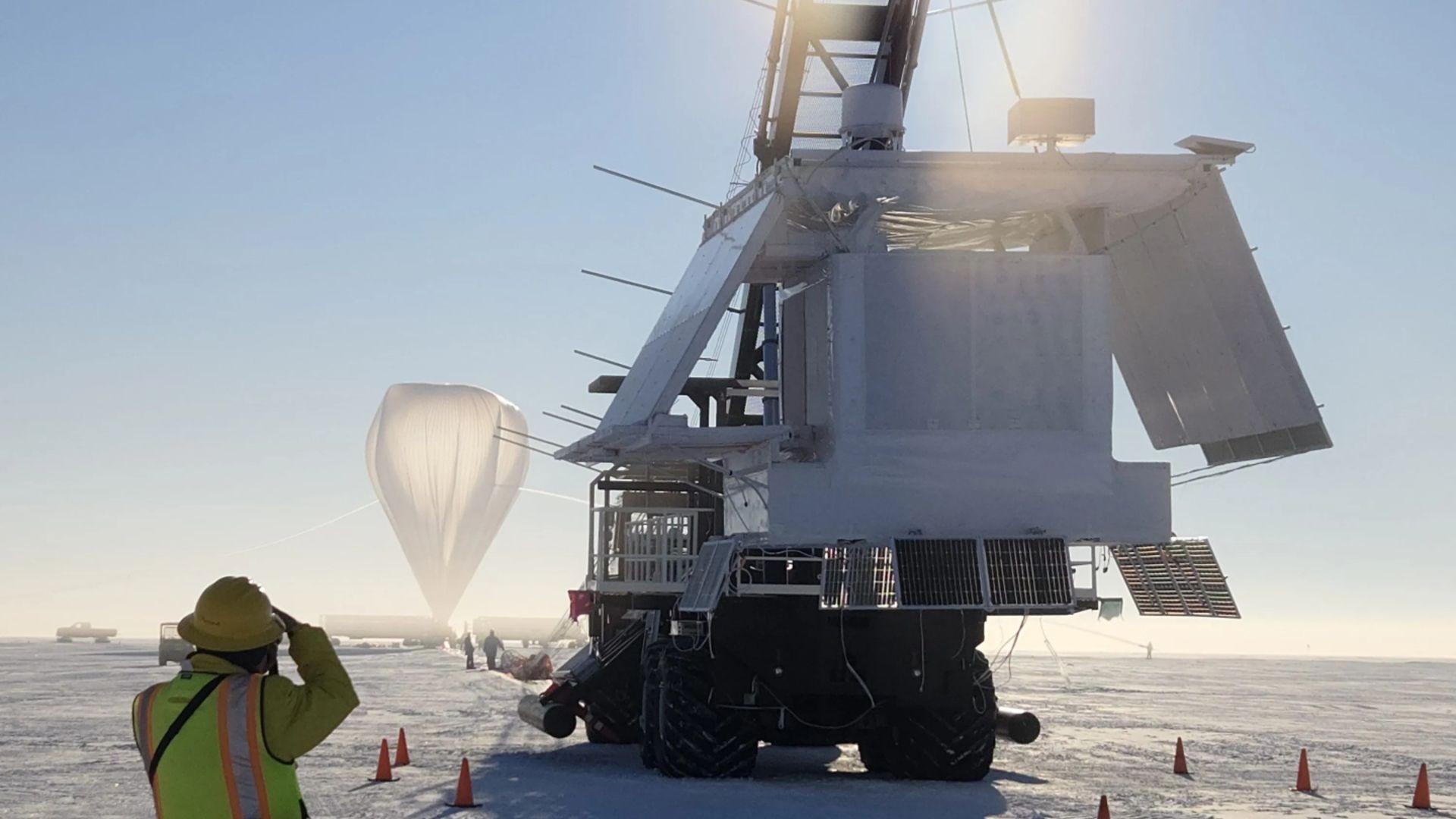
NASA has launched a high-altitude scientific balloon from Antarctica, initiating a mission to detect rare antimatter particles that could unlock secrets about dark matter. This method offers a cost-effective alternative to space missions while still enabling cutting-edge astrophysics, heliophysics, and Earth science research.
Why Antarctica?
The Antarctic environment is uniquely suited for long-duration balloon flights. During the austral summer, stable wind patterns and near-constant sunlight allow payloads to remain airborne for days or even weeks, circling the continent and collecting continuous data. NASA’s Antarctic Long-Duration Balloon campaign operates from a facility on the Ross Ice Shelf near McMurdo Station, taking advantage of these conditions.
The GAPS Experiment
The first launch of the 2025 campaign, which occurred on December 16, carried the General AntiParticle Spectrometer (GAPS). This instrument aims to detect antimatter nuclei—specifically antideuterons, antiprotons, and antihelium—which have never been definitively observed in cosmic rays.
Why is this important? If GAPS detects even a single antideuteron, it could provide crucial evidence about the nature of dark matter. Dark matter constitutes most of the universe’s mass but remains invisible to current detection methods. GAPS uses a time-of-flight system to measure particle speed and a tracker system to record interactions, enhancing its ability to identify these elusive particles.
The Bigger Picture
High-altitude balloons represent a powerful tool for scientific exploration. They can reach altitudes of roughly 120,000 feet (36.6 kilometers) above Earth’s atmosphere—higher than most aircraft fly—at a fraction of the cost and logistical complexity of sending payloads into orbit.
“Antarctica provides ideal conditions for long-duration balloon missions, allowing us to gather data for extended periods without the constraints of traditional space launches.”
The GAPS project is now underway, and the data collected will contribute to our understanding of dark matter, the universe’s most mysterious component. The findings from this mission could reshape our understanding of cosmology and fundamental physics.
Ultimately, this campaign highlights NASA’s commitment to innovative, low-cost approaches to space science, opening new avenues for discovery beyond conventional orbital missions.