


Nickel is not just the metal inside your pocket change. It is the quiet workhorse behind modern infrastructure. While coins are a nice historical footnote, the real story of nickel processing lies in its industrial dominance. This metal powers everything from chemical plants to renewable energy systems.
The material’s value comes from a stubborn combination of physical traits. It does not rust easily. It survives extreme heat and cold. It bends without breaking. These properties are not accidental. They are baked into the metal’s atomic structure.
Why Nickel Matters More Than Ever
The melting point of pure nickel is 1,453 °C (2,647 °F). That is hotter than most furnaces. Yet, the metal remains ductile. It can be shaped. This is due to its face-centred cubic crystal structure. It is a rigid yet flexible lattice.
But the real magic happens when nickel mixes with other elements. Take stainless steel. It is mostly iron and chromium. The chromium creates a protective oxide film. This film stops rust. But nickel stabilizes that film at room temperature. Without nickel, the steel structure would change in ways that weaken it.
This specific combination allows for austenitic stainless steel. These materials are non-negotiable in the chemical, petrochemical, and power industries. They withstand corrosion in wide varieties of media. They hold up where other metals fail. Modern technology depends on them. You cannot build a sustainable energy grid or a safe nuclear plant without this specific alloy.
A History Written in Myth and Metal
Humans have been using nickel for nearly two millennia. They just did not know what it was.
Around 200 BCE, Chinese miners in Yunnan province extracted a white alloy. It was a mix of zinc and a copper-nickel ore. They called it pai-t’ung. It was exported to the Middle East and eventually Europe. For centuries, it was treated as a curiosity. It was valuable, but misunderstood.
Fast forward to the miners of Saxony. They dug up an ore that looked like copper. When they tried to smelt it, they got useless slag. It refused to work. The miners believed it was bewitched. They blamed the devil. Specifically, “Old Nick.”
This gave the ore the name kupfernickel. Old Nick’s copper.
In 1751, a Swedish chemist named Axel Fredrik Cronstedt studied this “bewitched” ore. He isolated the metal. He proved it was a new element. It was not copper. It was not iron. It was nickel.
By 1776, scientists confirmed what Chinese artisans knew empirically. Pai-t’ung was copper, nickel, and zinc. We call it nickel-silver today.
Demand for this alloy spiked in England around 1844. The development of silver electroplating needed a base material. Nickel-silver was the best option. It was stable. It took the silver coating well. Later, pure nickel emerged as a corrosion-resistant plating itself. Both uses remain critical industries today.
The Global Hunt for Nickel
The hunt for this metal shifted the global economic map.
Small amounts were produced in Germany in the mid-19th century. Norway supplied more. A small mine in Gap, Pennsylvania, tried to keep up. Then came New Caledonia in the South Pacific around 1877. It dominated production for decades.
Then Canada struck gold. Or rather, copper and nickel. The Copper Cliff–Sudbury region in Ontario became the world’s largest source after 1905. It changed the scale of mining entirely.
By the late 1970s, Soviet Russia overtook Canada in production. The Cold War was a race for resources as much as ideology.
Today, the ledger has shifted again. China leads the world in nickel production. Russia, Japan, Australia, and Canada follow. The supply chain is global. It is fragile. And it is essential.
Where the Metal Hides: Ores and Extraction
You cannot just dig up nickel. It is always mixed with other elements. The type of ore determines how you process it.
Sulfide Ores
Canadian deposits are primarily sulfides. They are complex mixtures of nickel, copper, and iron. The star player is pentlandite, with the chemical formula (Ni, Fe)9S8. It is followed by pyrrhotite, which ranges from FeS to Fe7S8. Some iron in that structure is replaced by nickel.
Chalcopyrite (CuFeS2) is the dominant copper mineral in these ores. There is also cubanite (CuFe2S3). These are not just nickel rocks. They are copper rocks too.
But the value does not stop there. These ores contain gold. Silver. The six platinum-group metals. Recovery of these byproducts is economically important. Cobalt, selenium, tellurium, and sulfur are also extracted. A single mine produces a portfolio of metals.
Laterites
The other major class is laterites. These are different. They are not mined from deep veins. They are the result of weathering.
Peridotite rock initially contains a small percentage of nickel. In subtropical climates, long-term weathering washes away the host rock. The nickel dissolves. It percolates downward. It concentrates in specific strata. This makes mining economical.
The deposits are soft. Often claylike. They sit near the surface. Garnierite, a nickel-magnesium silicate, is the richest form. But nickeliferous limonite makes up a major portion of these deposits.
New Caledonia’s famous deposits are garnierite. Other laterite deposits are scattered worldwide. They present unique problems. Mining them is different. Transport is different. Recovery is different.
The quality varies wildly. In 1900, ore from Le Nickel in New Caledonia delivered to the smelter contained 9 percent nickel. Today, that same operation delivers ore with only 1 to 3 percent nickel. The concentration has dropped. The processing has become more complex.
We process rock into metal. We strip the earth to build the future. The methods change. The demand only grows. The next step is always harder than the last.


Nickel doesn’t just sit in one place. It hides in two wildly different types of rock, and that difference dictates everything about how we dig it up. You have sulfide deposits. You have laterites. The methods to get them out are as different as night and day.
Sulfide ores are usually deep underground. Miners treat them like copper, using shafts and tunnels. Sometimes, early in a mine’s life, they might dig an open pit, but the trend is deep. Laterites are another story. That’s earth-moving on a massive scale. Huge draglines and front-end loaders strip away the topsoil, tossing out boulders and waste. The nickel-rich dirt gets loaded into trucks at the face and hauled straight to the smelter. No complex shafts. Just dirt moving.
The Heat Problem in Extraction
Once the ore is out, extraction follows a route similar to copper. Same general vibe. Same kind of machinery. But nickel demands more heat.
The equipment looks familiar, but it’s built tougher. You need higher-temperature refractories to line the furnances. You need serious cooling systems to keep everything from melting down. Why? Because nickel production runs hotter.
The path diverges sharply depending on the source. Sulfides and oxides behave differently in the fire.
“Oxide ores… do not produce the same reaction heats, making necessary the use of energy from other sources for smelting.”
With sulfide ores, the chemistry helps. Oxygen reacts with iron and sulfur in the rock. That reaction creates heat. It supplies a portion of the energy needed to melt the ore. The mine essentially powers part of its own refining process.
Oxide ores? They don’t give that gift. They don’t generate reaction heat. You have to pump in energy from external sources. It costs more. It requires more fuel. The math changes.
Separating the Nickel from the Noise
Take sulfide ores first. They start crushed and ground. The goal is simple: liberate the nickel minerals from the waste. You use selective flotation.
Here is how it works. You mix the crushed ore with special reagents. Then you agitate it. Mechanical and pneumatic devices pump air bubbles through the slurry. The sulfide particles love the bubbles. They stick to them. As the bubbles rise, they drag the nickel with them. You collect this froth. It becomes a concentrate containing 6 to 12 percent nickel.
The waste? Tailings. Sometimes you run it through a second cleaning step. You squeeze every last bit of value out before dumping it.
Magnetism also plays a role. Some nickel-bearing sulfides are magnetic. You can use magnetic separators instead of, or alongside, flotation. It’s a tool in the belt.
Complex deposits like Sudbury add another layer. The copper content there rivals the nickel. You can’t just let them mix. The concentrate goes through a second selective flotation. Copper floats separately. Nickel stays behind. You end up with two distinct streams: a low-nickel copper concentrate and a pure nickel concentrate. Each goes to its own smelting line.
It’s not just digging. It’s separation. It’s chemistry. It’s heat management. The ore doesn’t care about your schedule. It only responds to pressure and temperature.
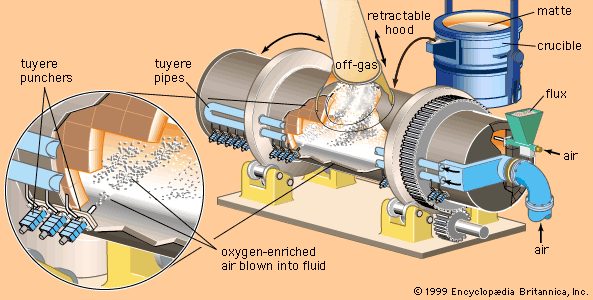

Nickel doesn’t play by the rules of copper. You can leach concentrates with sulfuric acid or ammonia. Or you can dry them and throw them into flash and bath smelters. But if you go the smelting route, you need serious heat. We’re talking 1,350 °C (2,460 °F). That’s how you get matte, an artificial nickel-iron sulfide containing 25 to 45 percent nickel.
The next step is brutal. You take that matte and put it in a rotating converter. It’s the same type used for copper, but the chemistry is different. Iron gets converted to an oxide. It combines with silica flux to form slag. You draw off the slag. What’s left? A matte of 70 to 75 percent nickel.
Why stop there? Why not go straight to metal? Because converting nickel sulfide directly to metal requires temperatures exceeding 1,600 °C (2,910 °F). That’s unmanageable. So, you control the sulfur removal. You keep the sulfur in just enough to lower the melting point. You end up with that 70–75 percent matte. But there’s a cost. Most nickel concentrates have a high sulfur-to-nickel ratio. That sulfur is a major pollutant. It increases the burden on smelters to contain it. You don’t just get metal. You get a waste management nightmare.
Taming the Matte
Smelters use different paths to treat this matte. One route is the ammonia pressure leach. Here, nickel is recovered from solution using hydrogen reduction. The sulfur? It becomes ammonium sulfate. That’s fertilizer. A useful byproduct.
Another path is roasting. You roast the matte to get high-grade nickel oxides. Then you pressure leach those oxides. The solution goes through electrorefining. Or carbonyl refining.
Electrorefining deposits nickel onto pure cathodes. It happens in sulfate or chloride solutions. The cells use diaphragm compartments. This stops impurities from jumping from anode to cathode. Clean metal.
Carbonyl refining is different. You pass carbon monoxide through the matte. You get nickel and iron carbonyls. Specifically Ni(CO)4 and Fe(CO)5. Nickel carbonyl is a volatile vapor. It’s also extremely toxic. Purify it, then decompose it on pure nickel pellets. You get nickel shot. The residue? Copper, sulfur, and precious metals. They get treated separately.
Laterites: The Sulfur-Free Problem
Laterite deposits are different. They’re oxide ores. Free of sulfur. No sulfide pollution problems. But they demand energy. Lots of it. And mining them destroys the environment. Soil erosion is a given.
Concentration processes don’t work well on oxides. You can’t wash the impurities away easily. You have to smelt massive tonnages. The ore is wet. 35 to 40 percent water. Some is moisture. Some is chemically bound as hydroxides. You have to remove it all.
Enter the rotary kilns. You need big ones. Dryers are 50 meters long and 5.5 meters in diameter. Reduction kilns are even bigger. 5 to 6 meters in diameter. Over 100 meters long. You need that retention time to handle the volume.
Then comes the reduction. You need electric furnaces. Modern laterite smelters use units rated at 45 to 50 megavolt-amperes. The temperature range is 1,360 °C to 1,610 °C (2,480 °F to 2,930 °F). Why so hot? The magnesia content in laterites is high. The liquidus temperature of the products is high. You need cooling blocks in the refractory lining. Extensive systems. Without them, the furnace melts.
Some plants add sulfur. They produce furnace matte. They treat it like sulfide matte. Most don’t. They produce crude ferronickel. It goes into steelmaking. It’s an alloying agent. But first, they remove silicon, carbon, and phosphorus. Impurities that weaken the steel.
The Metal’s Hidden Role
Pure nickel is weird. It’s corrosion-resistant. Strong. Ductile. Even at extremely low temperatures. It has electronic properties. Special magnetic properties.
It’s a catalyst. A good one. It hydrogenates unsaturated compounds. Think vegetable, animal, and fish oils. It turns liquids into solids. Shortening. Oleomargarine. Soap. You eat these things every day. Nickel made them possible.
Television tubes? They need oxide-coated cathodes. Nickel is the base. All of them. Radio power tubes, too, except the largest ones. Submarine cable amplifiers use a specific alloy. Nickel with 2 percent tungsten and a trace of magnesium. It has to work for 20 years without attention. No maintenance. Nickel makes that longevity.
Jewelry loves nickel. White gold is just gold, nickel, copper, and zinc. High purity. The white color is attractive. Nickel’s own color is white. Alloys with copper are substantially white. It forms strong, ductile alloys with iron, chromium, cobalt, copper, and gold. Industry uses this.
Plating for Protection
Nickel resists corrosion. Fluorine? Yes. Alkalies? Yes. Organic materials? Yes. It stays bright indoors. Outdoors, it tarnishes. But the corrosion rate is very low.
That low rate matters. It’s resistant to sodium chloride. And other chlorides. The stuff used on roads in winter. That’s why nickel is essential as an undercoat. Chromium-plated automotive trim relies on it. Without the nickel undercoat, the chrome fails. The steel rusts.
Heavy nickel plating is used elsewhere. Tank cars. Large pipes. Chemical industry equipment. Inner walls. If you’re storing corrosive chemicals, you line the tank with nickel. It holds up. It doesn’t care about the salt on your windshield.
“Nickel is essential as the base for oxide-coated cathodes used in all television tubes and all but the largest radio power tubes.”
The metal is everywhere. In your car trim. In your food. In the cables beneath the ocean. You don’t see it. But you can’t live without it. The process to get it is hot. Dirty. Energy-intensive. The end product is clean. Strong. Useful.
We strip the sulfur. We roast the oxides. We leach the ammonia. We build kilns the size of buildings. We pump megawatts into furnaces. All for a metal that sits on the shelf in jewelry stores and plating tanks. It doesn’t look like much. It’s just a gray solid.
But it’s the backbone of a lot of infrastructure. And a lot of consumer goods. The complexity of the supply chain is hidden by the simplicity of the final object. A button. A pipe. A screen.
The question isn’t whether we need nickel. It’s whether the environmental cost of extraction is worth the durability of the alloy. We know the answer to the first part. We’re still arguing about the second.
Why Copper and Nickel Make Better Metal
The real magic of metallurgy happens when you blend nickel with copper. It isn’t just about mixing metals; it’s about creating something that resists the ocean’s worst impulses. Take Monel metal. It’s mostly nickel—about 67 percent—with the rest being copper. It’s tougher than pure nickel and doesn’t care much about corrosion. This makes it indispensable in marine environments. Seawater moves fast, eroding weaker metals. Monel shrugs it off.
Engineers take it further by adding tiny amounts of aluminum and titanium. This triggers a process called precipitation hardening. The result? A high-strength version of the alloy that holds up under extreme stress. Propeller shafts love this stuff. They spin, they vibrate, they get pounded by water pressure. Monel handles it.
If you tweak the recipe to 55 percent copper, you get Constantan. It’s an electrical resistance alloy. Connect it with pure copper, and you have a thermocouple. These measure temperature by generating a voltage. Simple. Reliable.
Then there are the lower-nickel versions. 30 percent nickel, 10 percent nickel. Usually mixed with small doses of iron. They come out as tubes. Heat exchangers need them. Condensers need them. Why? Because seawater eats through standard pipes. These alloys don’t. Desalination plants run on them. The water is salty, hot, and aggressive. The tubes stay intact.
Add tin, silicon, or phosphorus to copper-based alloys, and you can harden them too. Specific uses. Niche markets. But essential ones.
Nickel-Silver and Coinage History
People still get the name wrong. Pai-t’ung is ancient Chinese alloy. Today, we call it nickel-silver. It contains 10 to 30 percent nickel. The rest is copper and zinc. Despite the name, there is no silver in it. It’s just a base for it.
It’s the standard substrate for silver-plated ware. Why? It looks good. It holds plating well. It’s durable. Beyond tableware, it springs in relays. It opens and closes circuits millions of times.
Coinage has a love affair with these metals. In 1860, Belgium adopted a 25 percent nickel, 75 percent copper blend. It’s essentially white. Five years later, the United States followed suit. More recently, countries use this alloy as the outer layer of copper-centered coins. It provides durability and a distinct look.
Switzerland went even purer. In 1881, they adopted pure nickel for coinage. Other countries copied them. Why? Because pure nickel is hard to counterfeit. It’s heavy. It rings true. It lasts.
The Magnetism Factor
Nickel does something weird. It changes length when magnetized. This is magnetostriction. Engineers use this property in ultrasonic transducers. Underwater defense devices rely on them. They send sound pulses into the dark water. They listen for echoes. The nickel transducer converts electrical signals into physical vibrations and back again.
But the story gets better. Mix nickel with 21 percent iron. You get Permalloy. Discovered at Bell Telephone Laboratories in 1916. It has extraordinary magnetic permeability in weak fields. Translation: it amplifies weak magnetic signals efficiently. Long-distance telephone transmission needs this. Undersea cables carry these signals across oceans. Without Permalloy, the signal fades. With it, you can hear voices from across the Atlantic.
Other alloys handle stronger fields. 45 to 50 percent nickel, rest iron. They work where the magnetic pressure is higher. Different jobs. Same family.
Permanent Magnets and Electrical Devices
The 1930s saw a boom in permanent magnets. It started in Japan. Early alloys had 25 percent nickel, 12 percent aluminum, rest iron. They were good. But then the Netherlands stepped in. They developed Alnico V.
Alnico V is a mouthful. 8 percent aluminum. 14 percent nickel. 24 percent cobalt. 3 percent copper. Rest iron. Heat-treat it in a magnetic field, and it becomes incredibly powerful. These materials changed everything.
Magnetic separators? They use Alnico. DC motors? Yes. Automobile generators? Absolutely. Before these alloys, motors were bulky. Inefficient. With Alnico, you get more power from less weight. The design of electrical devices shifted. Smaller. Stronger.
Invar and the Problem of Expansion
Heat makes metal expand. Cold makes it contract. This is a problem for precision instruments. Enter Invar. Discovered in 1898. It’s 36 percent nickel, rest iron. It has almost zero thermal expansion.
It doesn’t care about temperature changes. This makes it perfect for thermostats. It also makes it ideal for balance wheels in watches. A watch that expands in summer and contracts in winter keeps bad time. Invar doesn’t.
It seals metal to glass. Electric lights need this seal. If the metal expands more than the glass, the seal breaks. Vacuum leaks. Bulb dies. Invar prevents this. Radio tubes use it too. Precision matters when you’re building the early infrastructure of communication.
High-Strength Steel for Extreme Conditions
Nickel’s first big market was armor plate. James Riley in Glasgow worked on it in 1889. The U.S. Navy tested French steel in 1891. Military demands drove the industry. Bullets hit steel. Steel needed to absorb the energy without shattering.
But peace brought new demands. Steam turbines. Automobiles. Agricultural machines. Aircraft. These needed strength without excessive weight. Steels with 0.5 to 5 percent nickel emerged. Mixed with chromium and molybdenum, they became high-strength materials.
Then came liquefied gases. Cryogenics. You can’t use standard steel at ultralow temperatures. It becomes brittle. It shatters like glass. You need 9 percent nickel steel. Or higher nickel alloys. Carbon hardens these steels. Nickel toughens them. It slows the hardening process. This allows larger sections to be heat-treated without cracking.
Then came maraging steel. Carbon-free. 18 percent nickel. Plus cobalt, titanium, molybdenum. Heat-treat it, and you get tensile strength of 2,000 megapascals. That’s 300,000 pounds per square inch. Yet it stretches 5 to 10 percent. It’s tough and strong. A rare combination.
Heat Resistance and the Jet Age
Nickel doesn’t oxidize easily at high temperatures. It resists electrical erosion. This makes it perfect for spark plug electrodes. Automobiles need reliable ignition. Magnesium alloys in the electrodes last longer with nickel.
Add 15 to 20 percent chromium, and you get vast oxidation resistance. Electric resistance heaters use these alloys. They glow red hot for years without burning through.
Industrial applications demand more. 15 to 20 percent chromium, various iron amounts. Or 35 percent chromium, 20 percent nickel, rest iron. These handle wide temperature ranges. They stay strong. They resist corrosion.
Add aluminum and titanium. Precipitation treatment kicks in. The alloy strengthens further. This general class of alloys made the jet aircraft engine possible. Jet engines operate at insane temperatures. The turbine blades face direct flame. They need alloys that won’t melt or weaken.
Gas turbines use the same materials. They are growing in importance for industrial power. The grid needs reliable generation. These alloys keep the turbines spinning. They keep the lights on.
The connection between nickel and modern life is thicker than you might think. From the coins in your pocket to the engines flying overhead, nickel is the hidden structural element. It changes properties. It resists decay. It holds things together.
What happens when we run out of easy-to-mine nickel? The alloys won’t disappear. They’ll just get recycled more efficiently. The chemistry remains the same. The applications evolve. The ocean still needs corrosion-resistant metal. The jet engines still need heat-resistant alloys. The demand shifts, but the need remains.
We build with what we have. Nickel is part of that foundation. It’s not flashy. It doesn’t get the headlines. But without it, the infrastructure of the modern world would be significantly weaker. And significantly shorter-lived.
The next time you look at a spark plug or a coin, remember the nickel. It’s doing work. Quietly. Effectively.
You think of nickel as a shiny coin or a battery component. But its biggest job? Keeping steel from rotting.
That is the real story.
The stainless steel industry is the single largest consumer of nickel. We are talking about a massive chunk of global production. These alloys range from the classic 18-8 mix (18% chromium, 8% nickel) to heavier hitters with 25% chromium and up to 40% nickel.
Why does this matter? Because corrosion resistance isn’t just about looking good. It’s about structural integrity. You need materials that resist stains and hold up under pressure. The 18-8 variety is the most famous. But the high-nickel grades handle harsher environments. They are the workhorses of industrial design.
How nickel powers electroplating baths
Once the metal is alloyed, it often gets a coat. Electroplating is where nickel chemistry gets complicated.
The workhorse here is nickel sulfate hexahydrate. It is the standard in electrolytic refining and most plating baths. But you rarely see it alone.
Nickel chloride hexahydrate usually joins the party. It helps the plating process move faster and more evenly. If you are looking at newer plating technologies, you might see nickel sulfamate or nickel fluoborate. These are less common. They serve specific, high-performance niches.
This isn’t just about coating a toaster. It is about precision. Engineers need specific chemical balances to get that mirror finish or that protective layer on turbine blades.
The toxic and the useful in nickel compounds
Not all nickel compounds are for plating. Some are for analysis. Some are for refining. And some will kill you.
Take nickel dimethylglyoxime. It is an insoluble salt. Chemists use it to precipitate nickel out of a solution. It is a diagnostic tool. It tells you exactly how much nickel is in a sample.
Then there is nickel carbonyl. It is a liquid at room temperature. It is also poisonous. Like all carbonyls, it is deadly. Yet, it is essential. It is the key to the carbonyl nickel-refining process. Without it, we cannot get pure nickel for high-tech applications.
In pyrometallurgy—the high-heat extraction of metals—you encounter nickel subsulfide (Ni3S2). It is part of the “matte,” the molten mixture that sits between the ore and the final metal. It is a messy intermediate step. But it is necessary.
Nickel oxide (NiO) shows up in refining processes. Sometimes it is a byproduct. Sometimes it is the end product. It depends on what you are trying to make.
The chemistry is rigid. You follow the compounds, or the process fails.
“The largest single use of nickel is in the production of stainless steel.”
This fact alone explains why nickel prices swing with construction trends and manufacturing demand. It is not just a metal. It is infrastructure.
We rely on these specific compounds to refine, coat, and strengthen the world around us. The toxicity of carbonyl nickel is a risk we manage. The


